Apparel
DTF vs. DTG vs. Screen Printing: Which Is Right for Your Business?
The Rise & Tide Team · October 15, 2026 · 6 min read
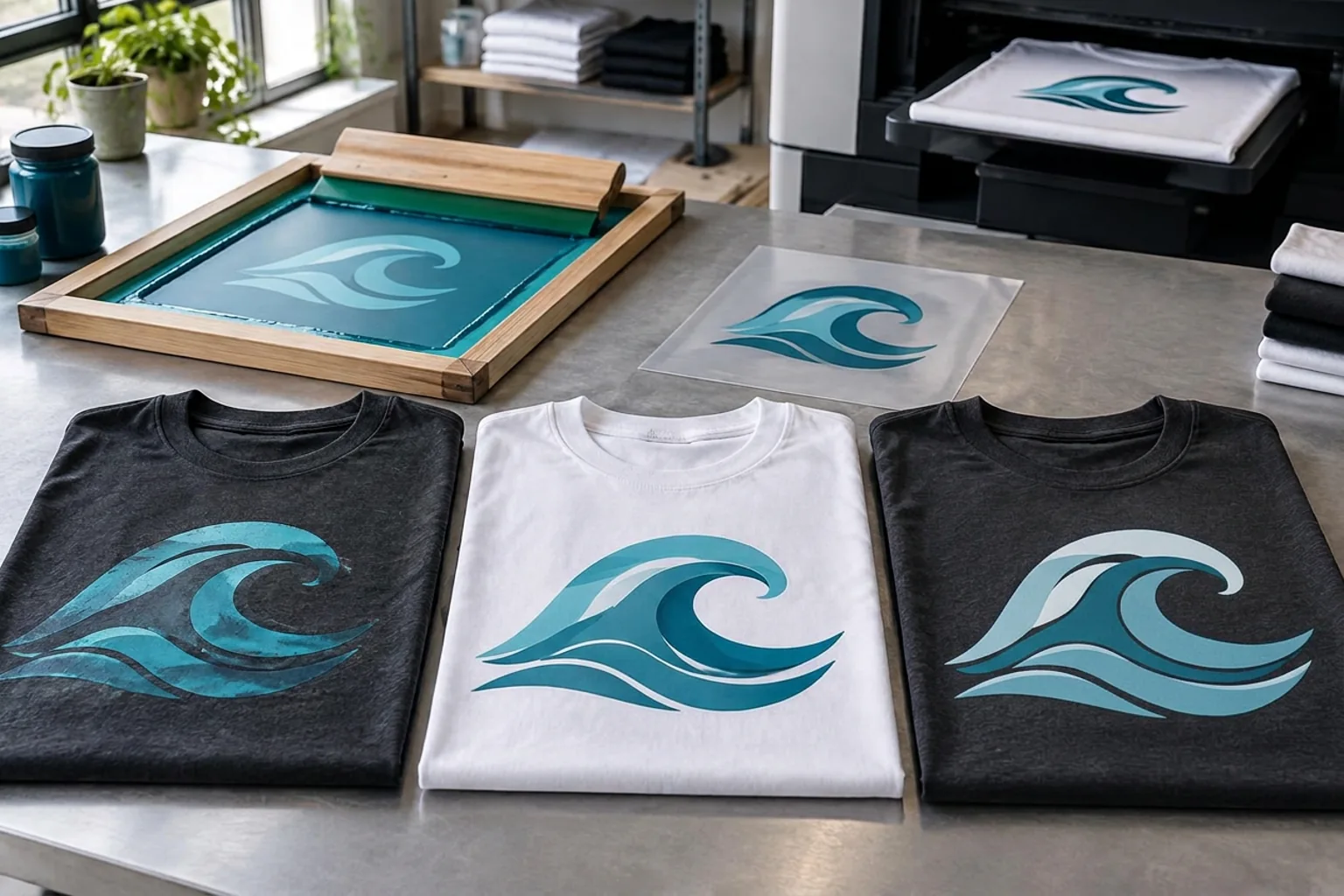
Your logo might look the same on a screen, but the way it reaches a shirt changes how that shirt feels, wears, and fits your budget. DTF, DTG, and screen printing are all useful tools. None is the automatic winner for every business. The right choice starts with the people wearing the garment, the artwork, and the number of pieces you actually need.
Think of printing as part of the whole piece, not a finish you choose in isolation. A lightweight staff tee with a small chest logo asks different things of a print than a heavyweight retail shirt with a full-front illustration. Here is how to make that decision with a little more confidence.
DTF: detailed artwork, transferred with heat
Direct-to-film printing starts with a digital printer laying color and a white backing onto a special transfer film. Heat-activated adhesive powder is applied to the wet ink and cured. A heat press then bonds the design to the garment; the film is peeled according to the transfer system’s instructions. The print stays on the shirt, not the film.
DTF handles multicolor logos, gradients, and detailed artwork without a separate screen for each color. It can work on cotton, polyester, and many blends, which makes it a practical candidate for mixed garment orders and small runs. Compatibility still needs checking: heat-sensitive fabrics, water-resistant coatings, and dye migration on polyester can create problems. Press settings and transfer quality matter as much as the file.
The trade-off is feel. DTF adds a bonded layer, and a large solid graphic can feel less breathable than an open design. Small logos or artwork with plenty of negative space usually feel less noticeable. Good transfers can hold up well, but correct application and washing care are essential; no method makes a shirt indestructible.
DTG: inkjet printing directly onto the garment
Direct-to-garment printing uses an inkjet printer to apply textile ink straight onto the fabric, followed by curing. Cotton-rich garments, especially smooth, high-quality cotton, are typically its strongest starting point. Pretreatment helps control ink and is particularly important when printing a white underbase on dark garments. Polyester and blends require a suitable printer, ink system, pretreatment, and testing; they are not interchangeable with cotton.
DTG is a strong option for illustrations, photographic images, and designs with many colors. There is no individual screen to prepare for each color, so short runs and artwork variations are practical. On light cotton, prints can feel especially soft. On dark shirts, the white ink layer can be more noticeable. Fabric texture, pretreatment, artwork coverage, and curing all affect the result.
Its strengths do not make DTG the cheapest choice for every order. Printing each shirt takes time, and heavy ink coverage can add cost. When hundreds of garments share a simple graphic, another method may offer a better production fit.
Screen printing: setup that pays off at scale
Screen printing pushes ink through a mesh screen with a stencil onto the garment. In a typical spot-color design, each color needs its own screen and a separate pass, followed by proper curing. Preparing and aligning those screens takes time. Once the setup is ready, the same design can be repeated efficiently across a larger run.
That is why screen printing often becomes attractive as quantities rise, especially with one or two colors. There is no universal break-even quantity: artwork, print locations, garment choice, ink, and the supplier’s setup costs all influence the quote. Full-color images are possible through halftones and process techniques, but they require skilled preparation and are not always the simplest route.
Feel depends on the ink and application. Plastisol can produce a noticeable surface print; water-based systems can feel softer on suitable fabrics. Discharge printing has its own fabric and dye limitations. Cotton, blends, and polyester can all be candidates with the right ink system, including attention to dye migration. Ask about the actual combination rather than assuming every screen print feels alike.
Compare the methods at a glance
| Consideration | DTF | DTG | Screen printing |
|---|---|---|---|
| Print feel | Bonded layer; solid areas feel more noticeable | Often soft on light cotton; white underbases add feel | Varies with ink, coverage, and fabric |
| Color complexity | Multicolor and gradients without separate screens | Detailed, photographic, multicolor artwork | Simple spot colors are efficient; full color needs preparation |
| Fabric compatibility | Cotton, polyester, many blends; test heat and coatings | Usually best on cotton-rich fabric; specialty systems vary | Many fabrics with appropriate inks and curing |
| Smaller orders | Often practical for colorful logos and mixed garments | Often practical for detailed cotton graphics | Setup may outweigh savings |
| Larger orders | Viable; compare press time and coverage costs | Viable; compare print time and ink costs | Often economical for repeated, simple designs |
Three real-world decisions
Twelve shirts with a colorful business logo: DTF is a sensible method to discuss first. It avoids preparing multiple screens for a short run and can accommodate suitable garment blends. Keep the logo’s dimensions intentional; a compact chest mark feels different from a solid full-front transfer.
A premium cotton tee with a detailed graphic: DTG deserves a look, particularly when the design has shading or photographic detail and the order is small. Compare a sample on the actual shirt color. A dark garment’s underbase may change both the feel and the appearance you expected.
Five hundred shirts with the same simple design: screen printing is often the logical starting point. The setup is spread over many pieces, and repeat printing becomes efficient. Still compare complete quotes: extra print locations, additional colors, or individual personalization can change the economics.
Start with the shirt, then choose the print
Garment quality and fit matter just as much as the decoration. Consider fabric weight, softness, shrinkage, and whether the cut suits your team. A beautifully printed shirt that nobody enjoys wearing does little for your brand. If the order matters, ask for a garment sample and discuss a printed sample or proof before committing.
At Rise & Tide, the conversation starts with your business, not a machine. Share your artwork, quantity, preferred garments, budget, and deadline. We can help you weigh the options and plan the right apparel solution, including discussing which production approach fits the project. The aim is a shirt that earns its place in someone’s regular rotation.
Ready to put the right shirts to work? Explore business packages for a starting point, or request a custom quote for your design and quantity.
Every Brand Has a Story. Every Shirt Tells One.