Community Stories
Building Rise & Tide: The Story Behind the Shirts
The Rise & Tide Team · October 15, 2026 · 5 min read
A suitable sink might not sound like the beginning of an apparel company. But when Eric and Natalie explored screen printing, the lack of one became a deciding factor. Their shop did not have the sink and cleanup setup that messy screen printing needed. Before they could make shirts that way, they would have to solve a very practical problem: where would the cleanup happen?
That constraint did not end the idea. It changed the direction. The story behind Rise & Tide starts there—not with a perfectly equipped shop or a dramatic breakthrough, but with two people looking at what was possible and finding another way forward.
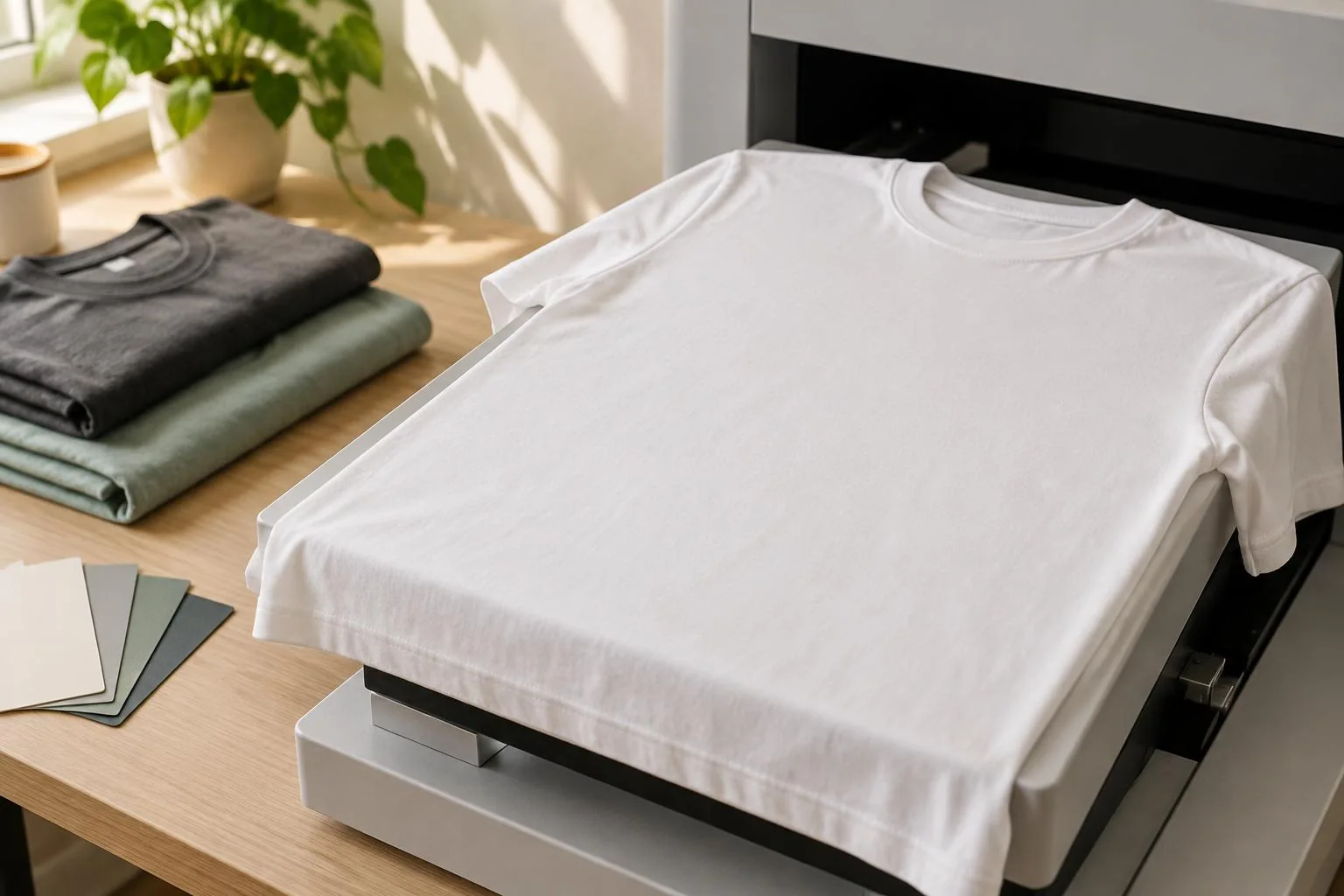
The image above is an AI-generated editorial illustration of garment-printing equipment, not a photograph of Eric and Natalie’s shop or the Brother printer they acquired.
An idea they kept talking about
Eric and Natalie continually discussed ways to expand what they were doing. T-shirt printing became one of those possibilities at a time when direct-to-garment printing, or DTG, was not yet widespread. There was more than one way to put a design on a shirt, but choosing a process also meant choosing the work that came with it.
Screen printing was the route they initially explored. It is an established method, and it was a reasonable place to begin investigating. But a method can make sense in general without being a good fit for a particular space. In their shop, the missing sink and cleanup setup were not minor details they could simply ignore.
The useful question became less about following the first plan and more about finding a process they could actually support. That distinction is easy to overlook when an idea is exciting. Equipment has to belong in the place where the work happens, not just look promising on paper.
A different route to the same idea
They investigated alternatives and chose a Brother garment printer. The goal of making shirts remained; the way of getting there changed. Instead of treating the screen-printing obstacle as a reason to stop, they found another approach.
That decision is not a claim that one printing method is always better than another. Screen printing and garment printing each have their place. Here, the choice was grounded in their circumstances. The right next step was the one that made sense for the shop they had.
There is something refreshingly ordinary about that kind of adaptability. It does not require a grand reinvention. Sometimes it means being willing to revisit an assumption, investigate an alternative, and keep the original purpose in view. Eric and Natalie were still working toward shirts. They had simply found a different path to making them.
Shirts for the SofaKillers
After acquiring the Brother printer, they began making shirts for Eric’s brother-in-law’s band, the SofaKillers. The idea now had a real use: apparel connected to people they knew and something those people were creating.
That is an important part of the story without needing to turn it into a legend. Making those band shirts was a concrete beginning. It does not need an invented sales milestone, a glowing customer quotation, or a claim that it immediately became a much larger operation to matter.
The connection also says something about why shirts can be meaningful. A band already has its own identity; a shirt gives that identity another form. The garment is not the whole story. It is a way to carry a piece of it beyond the thing that first brought people together.
One Idea Led to Another
Eric remembers seeing shirts other people wore or sold and thinking, “We could do that too.” The thought was never about repeating someone else’s design. It was curiosity about the making: how a blank garment becomes a finished one, what the equipment actually does, and what they would need to learn in order to make something themselves.
Eric and Natalie kept discussing ways to expand their creative businesses. After Brother garment printing and those early SofaKillers shirts, their ideas and production capabilities expanded to a Glowforge laser cutter, then an embroidery machine, a 3D printer, and a UV printer. Each machine opened possibilities for new product categories, giving them another way to turn an idea into something tangible.
Laser cutting opened up possibilities beyond apparel; embroidery offered another way to work with garments. A 3D printer brought the possibility of creating dimensional objects, while UV printing opened another route to decorating products. Those were capabilities to explore, not a claim that every possible product became part of their work.
They were building capabilities, not just collecting equipment. The thread running through it was the same conversation that started with shirts: what else could they create? Rise & Tide grew from that expanding range of possibilities, with more ways to consider an idea rather than trying to make every idea fit a single process.
Building for themselves, then opening the door to others
Eric and Natalie later built Rise & Tide Apparel Co. to serve others. Work for our own brands and work for outside customers are distinct parts of that purpose. Our own-brand projects are not evidence of an outside customer portfolio, and we do not want to present them that way. The SofaKillers shirts belong to this origin story as work for Eric’s brother-in-law’s band, not as proof of a broad client roster.
What connects the beginning to Rise & Tide today is the invitation to help someone else make an idea tangible. Building together meant keeping the conversation going when the first approach did not fit. Serving others means making room for their circumstances, too: what they are creating, what the apparel needs to do, and which choices make sense for them.
If you are working through those choices, these Journal guides are a useful next stop:
The next story could be yours
We are not asking you to arrive with every decision made. Bring the idea and the practical questions that come with it. Explore our business packages for a starting point, or request a custom quote to begin a conversation about what you want to make. The beginning of Rise & Tide is a reminder that a constraint can change the route without taking away the possibility.
Ready to put the right shirts to work? Explore business packages for a starting point, or request a custom quote for your design and quantity.
Every Brand Has a Story. Every Shirt Tells One.